Women and Sick Leave

July 7, 2011

There has been a major brouhaha in New Zealand over the last couple of days over remarks made by the CEO of the Employers and Manufacturers Association, Alisdair Thompson. He cited sick leave as the reason for women being paid less than men.

Who takes the most sick leave? Women do, in general. Why? Because once a month they have sick problems. Not all of them, but some do. They have children that they have to take time off to go home and take leave of. Therefore it’s their productivity. It’s not their fault.

It wasn’t long before there was a paroxysm of outrage from feminists and Mr Thompson joined the ranks of the unemployed.

But was he right? Do women take more sick leave than men, and is it justifiable to pay them less than men for that reason?

Statistics are available for several countries, including New Zealand. Here are some of them:

  • In the New Zealand civil service in 2010 men took 6.8 days sick leave and women took 8.4 days on average.
  • In a 2004 survey in the UK, on any given day an average of 1.4% of men and 2.1% of women were on sick leave.
  • Swedish data indicate that women take about 1.5 days sick leave per quarter against 1 day for men.

So the statistics say that women are off work due to illness about 2 days per year more than men. Assuming that there are 200 working days per year these figures would justify a difference in salary of about 1%, not the 12% differential that actually prevails in New Zealand.

However, I don’t believe for a moment that the reason women are paid less has anything to do with sick leave, as Mr Thompson probably knows. The real reason is simply that women are prepared to work for less, and companies, as any wage slave knows, will pay the minimum amount possible to keep workers at their desks or machines.

Is it moral to discriminate against a group of people based on some statistical characteristic of that group? My every instinct says no, that people should be treated as unique individuals who should be judged on their own individual qualities. For example, some motor insurance premiums are higher for male drivers because statistically men have more accidents than women. I feel aggrieved because in the roughly four decades I have been a driver I have only claimed once, and that was because my car was kicked by a horse. I don’t hear mens’ liberationists (masculinists?) going into spittle-flying rages about this, or the CEOs of insurance companies being fired because of it.

But then it’s fine to be sexist provided you are a woman, and it’s OK to be a racist as long as you’re black.

Creative Commons License
Grumpy Old Man by Mark Widdicombe is licensed under a Creative Commons Attribution-Noncommercial-No Derivative Works 2.5 License

//


Stellar Silliness

June 30, 2011

I received this offer the other day:

All About Name A Star:

Name a Star is ideal for:

Birthdays – Christmas – Valentine’s Day – Anniversaries – Engagements Weddings – Mother’s Day – Father’s Day – Baby Showers Showing Appreciation – Graduations – Retirements – Memorials

Give a gift that truely lasts forever. Name a Star is the ideal gift for friends and family of all ages and is perfect for those “hard to buy for” people.

Name a Star allows you to express your feelings with this special gift. Anyone is sure to be overjoyed when they receive this unique, personalized certificate.

For just R89 you can dedicate a star in our registry and get a beautiful, personalized certificate to present to your friends or family.

The certificate features the star’s celestial coordinates so it can be located easily using Google Sky.

If you fork over your R89 what are you getting? Do you imagine a couple of centuries hence astronauts setting course for a star system bearing your name? If so, you’re in for a disappointment–all you have bought is a certificate (actually a pdf file that you’ll have to print out yourself) signifying nothing; even though it might look lovely hanging on the wall next to your doctorate from Thunderwood College and your dog’s rabies innoculation certificate.

The truth is that no company can name a star on your behalf. Here’s what the International Astronomical Union has to say on the subject:

The IAU frequently receives requests from individuals who want to buy stars or name stars after other persons.  Some commercial enterprises purport to offer such services for a fee.  However, such “names” have no formal or official validity whatever: A few bright stars have ancient, traditional Arabic names, but otherwise stars have just catalogue numbers and positions on the sky.  Similar rules on “buying” names apply to star clusters and galaxies as well.  For bodies in the Solar System , special procedures for assigning official names apply (see the IAU theme “Naming Astronomical Objects“), but in no case are commercial transactions involved.

As an international scientific organization, the IAU dissociates itself entirely from the commercial practice of “selling” fictitious star names or “real estate” on other planets or moons in the Solar System. Accordingly, the IAU maintains no list of the (several competing) enterprises in this business in individual countries of the world.  Readers wanting to contact such enterprises despite the explanations given below should search commercial directories in their country of origin.

In the past, certain such enterprises have suggested to customers that the IAU is somehow associated with, recognizes, approves, or even actively collaborates in their business.  The IAU wishes to make it totally clear that any such claim is patently false and unfounded.  The IAU will appreciate being informed, with appropriate documentation, of all cases of illegal abuse of its name, and will pursue all documented cases by all available means.

Thus, like true love and many other of the best things in human life, the beauty of the night sky is not for sale, but is free for all to enjoy.  True, the ‘gift’ of a star may open someone’s eyes to the beauty of the night sky.  This is indeed a worthy goal, but it does not justify deceiving people into believing that real star names can be bought like any other commodity.  Despite some misleading hype several companies compete in this business, both nationally and internationally.  And already in our own Milky Way there may be millions of stars with planets whose inhabitants have equal or better rights than we to name ‘their’ star, just as humans have done with the Sun (which of course itself has different names in different languages).

So think twice before giving this “gift” to a loved one. She may realise that the thought counts for very little.

Creative Commons License
Grumpy Old Man by Mark Widdicombe is licensed under a Creative Commons Attribution-Noncommercial-No Derivative Works 2.5 License


Holford’s Folly

June 21, 2011

We have recently been bombarded with advertisements from a person called Patrick Holford who makes his nefarious living flogging unnecessary vitamin supplements to the gullible. It’s not surprising, therefore, that he defends the taking of vitamins in large doses for every conceivable ailment that could possibly afflict the human race, and if one happens to be healthy, then he advocates taking them anyway as a prophylactic measure. The problem with Mr Holford’s campaigns is that he is frequently economical with the truth to the point of comedy.

Here are some examples from a diatribe against the UK National Health Service (NHS), in which he criticises the NHS’s stance on vitamin supplementation. He claims that

The essential message is supplements don’t really work. They are probably dangerous and simply not worth the money. If you are sick what you need is drugs.

Which, needless to say, doesn’t suit Mr Holford’s interests. So he goes on the attack.

There has not been a single death from taking high dose vitamin supplements anywhere in the world. In the 35 years I’ve been in this field I haven’t encountered one serious adverse reaction to a vitamin, mineral or essential fat supplement.

Well, this is simply untrue. It is a lie, a porky pie, a whopper and a brazen fib. According to the 2004 Annual Report of the American Association of Poison Control Centers Toxic Exposure Surveillance System there were 62, 562 instances of vitamin overdose in the USA in 2004, 53 of which were life-threatening and 2 deaths actually occured. I remember doing an arctic survival course many years ago in which we were exhorted not to eat polar bear liver lest we fall victim to vitamin A toxicity, never mind the injuries that might accrue in obtaining the polar bear’s liver in the first place, particularly if it was still in use by the bear. Vitamins can be harmful. Holford goes on

If a supplement has an ‘active’ ingredient (meaning it works) it’s referred to the Medicines and Healthcare Regulatory Authority, and classified as a medicine, and banned for over the counter sale.

Well, exactly. The muck Holford flogs isn’t banned for sale over the counter. Draw your own conclusions.

But why is the NHS spending money persuading people not to take supplements?

Um, because they’re charged with protecting the nation’s health, perhaps?

I don’t know about you but I am getting pretty fed up with the money that’s being spent on propaganda to keep the pharmaceutical and medical industry in power while we, the public, get sicker and broker.

I wasn’t aware that the pharmaceutical and medical industries were “in power”, but I can quite understand why you don’t like the NHS’s stance on supplements. It makes Patrick Holford broker (well, slightly less stinking rich).

Holford was also responsible for advocating mega doses of vitamin C as a treatment for HIV infection instead of AZT. This should give you some idea of the extent of either his crackpothood or, depending on how generous you are feeling, his voracious appetite for profit.

Since he isn’t a doctor, I can’t call Holford a quack, but if he were he would be. Don’t waste your money on this flake’s rubbish.

Creative Commons License
Grumpy Old Man by Mark Widdicombe is licensed under a Creative Commons Attribution-Noncommercial-No Derivative Works 2.5 License


Euthanasia II

June 15, 2011

A couple of weeks ago Jack Kevorkian, a.k.a. “Doctor Death”, died from complications of liver cancer. Today we have news that Terry Pratchett, the esteemed science fiction author of the Discworld series, is suffering from early onset Alzheimer’s disease, and is campaigning for the right to end his life when and where he likes.

Jack Kevorkian


Well, why shouldn’t he? There seem to be two arguments against any individual choosing the time and manner of his own death: religious, and some variant or other of the “slippery slope”.

The religious argument is simple: only God can ordain the time of our death, and to pre-empt God is a mortal sin. Also inextricably tied into this argument is the notion that humans are fundamentally different to animals by virtue of the possession of a soul, and that what might be “humane” for animals must be rejected for humans on account of our special status.

The slippery slope arguments come in two broad categories. The first goes something like this: “If we allow people who are terminally ill to commit assisted suicide, then we’ll have people doing it who are just depressed or having a bad day.” The second is usually framed as the concern that relatives of the euthanasee might take the opportunity to bump off granny in order to get their avaricious hands on her chattels before she is ready to go, or that granny may feel she’s a burden to her family, so she undergoes assisted suicide as a considerate means of relieving that perceived burden.

I side with Kevorkian and Pratchett in this matter. Neither of the arguments mentioned above hold water, and even if they did they are trumped by a much more compelling moral argument.

The religious wish to impose the sovereignty of their god on everyone, whether or not they believe in that particular god. I do not believe in the existence of any gods, so obviously I must reject as absurd any attempt on the part of the religionists to impose their superstitions on any aspect of my life; and I must oppose as unconstitutional any laws that entrench religious ideals. I find the very notion that we assist animals to die painlessly when their pain becomes severe and call that “humane”, but refuse that same consideration to humans contrary to every tenet of morality, but that does not surprise me–the religious know very little about morality, and what they do know is distorted by the lens of their hand-me-down beliefs.

Slippery slope arguments can be disposed of quite easily simply by exposing the fact that they are straw men; they are objecting to matters that are not even on the table–no one is espousing murder, merely individual freedom of choice.

Which brings us to the clinching, in my view, moral argument. If we value the “right to life” as entrenched in the constitution, then we must acknowledge the concept of ownership of one’s life and body. Who owns your life and body? The church? Your neighbour? The state? Obviously not. You own it, and therefore you must be the sole arbiter of its final disposition. The corollary to this is that any law that attempts to prevent you from exercising your rights over your body is immoral and should be struck from the statute books, and the prosecution of those assisting others to die should be stopped immediately.

I see that the Catholic church saw it as “both ironic and tragic” that Jack Kevorkian did not himself resort to assisted suicide in his final days. Why? They miss the point entirely. He did not choose to do so, but he should have permitted to so choose if he wished. The religionists really don’t seem to able to get a handle on the logic of this argument at all.

Creative Commons License
Grumpy Old Man by Mark Widdicombe is licensed under a Creative Commons Attribution-Noncommercial-No Derivative Works 2.5 License


Drugs

June 6, 2011

The boarding school I attended when I was a small boy employed a Scottish matron to look after our medical welfare. She was rectangular, about four feet tall, had a broad lowland Scots accent, a face like a haggis and a loving heart, not that she would ever own up to that. Whenever we went to see her she would listen to our sad stories, then give us a large, round, blue pill. I always felt much better after this, and attributed the improvement to the pill. With hindsight, I’m sure the pill was nothing more than a multivitamin, and the talk conspired with the placebo effect to produce the improvement in mood. This is only tangentially relevant to my topic for today, which is illegal drugs and the relationship between their users and governments.

Judi Dench


Last week luminaries such as Judi Dench, Sting and Richard Branson expressed their view that the so-called war on drugs was a failure, and that use of illegal drugs should be decriminalised. Well, guys, thanks for pointing out the obvious–obvious to everyone, that is, apart from those legislators who persist in the delusion that they can legislate human nature.

The arguments for decriminalisation are practical: a huge amount law enforcement resources are diverted from fighting other crimes; outrageous profits on illegal drugs mean that the market is perfectly suited to exploitation by organised crime; the trade in illegal drugs cannot be regulated, so their consumers risk injury or death from poor quality merchandise; users are cast out of mainstream society and live dangerously, sharing needles and other kinds of risky behaviour.

In my view Dench et al don’t go far enough. Illegal drugs should not be decriminalised, they should be legalised. Apart from all the reasons given above for decriminalisation, there are compelling moral arguments for legalisation. The first is the lack of consistency in the law. There are no logical reasons why some drugs, such as alcohol and tobacco should be freely available to adults when less harmful substances such as cannabis are illegal. Secondly, there is the question of freedom: if you wish to have a free society, then adults should have freedom over their own bodies, which means the freedom to ingest any substance they like without being dictated to by the state. The function of government is to protect citizens’ rights against other people, not themselves. Free people must have autonomy over their own lives, and suffer government interference only when they infringe the rights of others.

Cannabis grow room (with rozzerette)


“But the the health system won’t be able to cope with millions of addicts!” critics will cry. This is simply untrue–the national fiscus takes in much more from taxes on the sale of alcohol than they expend on treating the fairly small proportion of drinkers who descend into alcoholism. Any drugs can be taxed in the same way as are tobacco and alcohol now, and the profits go to government (disorganised crime) instead of to the criminal cartels. Cynics or conspiracy theorists might make the point that government allows the sale of alcohol and tobacco because it saves a considerable amount of money; the best outcome for government is everyone dropping dead at their retirement parties, saving a fortune in pensions and geriatric care. A legal market in drugs can be regulated by health authorities, ensuring suppliers perform adequate quality control, and that users can be confident of the doses they are purchasing.

I’m sure that somewhere in the back of Richard Branson’s mind is the outline of the advertising campaign he will run upon the launch of Virgin Psychedelic, and the profits he will make out of marketing cheap, high quality product to an appreciative public.

Creative Commons License
Grumpy Old Man by Mark Widdicombe is licensed under a Creative Commons Attribution-Noncommercial-No Derivative Works 2.5 License


Stokes Croft Riots

May 26, 2011

A small branch of the supermarket Tesco opened in Stokes Croft, a neighbourhood in Bristol in April. This was not a giant hypermarket, it was a Tesco Express, something like Apu’s Quik-E-Mart in The Simpsons.

Riot damaged Tesco Express


Some residents in the area were horrified. They claimed that the new store would destroy existing small businesses, and that “big capitalism” was being imposed on them. Their opinions were not taken seriously, and the opening of the new store went ahead.

Those opposed to the store have this to say:

Within a week of Tesco opening its doors Stokes Croft has found itself the focal point of serious violence and confrontation. Over the last few years our beloved community has undergone an amazing home grown resurgence. We are therefore devastated that Tesco’s refusal to listen to what the majority of local people want has resulted in our vibrant, peaceful community being subject to such a sad state of affairs.

This “majority” decided that violence was the best method of enforcing their wishes, so they took to the streets. Their website goes on:

We are also deeply saddened to witness the reality that we live in society in which young people feel the only way to see justice done is to throw rocks. The reality is the government / corporations / media have created this society and are now trying to blame young people for the mess they have created. What future can we hope for if corporations are allowed to continue to dictate governments? If their insatiable appetite for profit is allowed to reign supreme?

Clashes between protesters and police left many injured and extensive damage to property, including to the disputed store.

What bothers me about this is that the protesters are either lying about their motives or they show an almost unbelievable ignorance of economic forces.

If they are truly in the majority, they could easily close the store down simply by not shopping there. The store would lose money, and Tesco, with its “insatiable appetite for profit” would close its doors and try again elsewhere.

But I suspect that they are not in any sort of majority and they wish to impose their political agenda on everyone else through the use of force. There may well be a silent majority of residents in the area who would appreciate the convenience of being able to buy reasonably priced goods at the new store, and the protesters are well aware of this fact.

This is morally indefensible and I hope the Avon and Somerset constabulary stand firm in their commitment to uphold the law.

What future can we hope for if a few malcontents are allowed to dictate, by violence and coercion, to corporations and governments?

Creative Commons License
Grumpy Old Man by Mark Widdicombe is licensed under a Creative Commons Attribution-Noncommercial-No Derivative Works 2.5 License


Rapture II

May 23, 2011

So, here we are (still). Unraptured, unsubjected to the tortures of hell on Earth we were promised by the grade A, Crackpot First Class Harold Camping. The papers are full of sob stories about the morons who bought into this nonsense and now have to face the consequences.

Last Judgement


Last week I expressed some sympathy for the likes of the Martinez family, but this week, after reading the bleatings of the faithful, I’ve changed my mind.

There are a crowd who rented 50 rooms in an expensive hotel to await Jesus, believing they would never be presented with the bill. How stupid can you get and still go about on your hind legs? These bloody fools deserve nothing but contempt and ridicule, and the more of that that is heaped upon them, the less likely will it be that others will believe the next Camping, or even this self same Camping when he amends his ridiculous calculations again.

Last week I mentioned the fact that yelling “fire!” in crowded auditorium is not protected speech under any sane constitution, and likened Camping’s absurd statements to just that situation. I sincerely hope someone in the US brings a prosecution against him, and a jury finds him responsible for some of the harm he has done.

Then he can finish his days in a lunatic asylum, where he should have been confined a long time ago.

Creative Commons License
Grumpy Old Man by Mark Widdicombe is licensed under a Creative Commons Attribution-Noncommercial-No Derivative Works 2.5 License


Rapture Rubbish

May 10, 2011

There have always been a few mentally fragile individuals going about wearing sandwich boards proclaiming the imminence of the end. But they are seldom as specific about it as the latest batch of ditzy doom mongers who say that the rapture will occur at 1800 local time on the 21st May.


Why are they so sure? Well, because it’s exactly 7000 years since the start of the great flood (you know, the one that happened when the only person with a boat was Noah), that’s why. How do they know the exact date of the flood? I don’t know and they aren’t telling, apart from a somewhat cryptic assertion that it is encoded in the Bible. The man who started all this is the well-known crackpot Harold Camping, the founder of a Christian media network called Family Radio. He predicted the day of judgement would come on September the 6th 1994, and when it didn’t his excuse was that he hadn’t actually read the whole thing: “For example, I at that time had not gone through the Book of Jeremiah which is a big book in the Bible that has a whole lot to say about the end of the world.”

Harold Camping

This is all very entertaining, but his nonsense has an adverse effect on the lives of those who are too weak or psychotic to think for themselves. For example: Adrienne Martinez and her husband Joel lived and worked in New York. Adrienne had plans to attend medical school, but when they fell under the spell of Camping, their plans changed. “Knowing the date of the end of the world changes all your future plans. My mentality was, why are we going to work for more money? It just seemed kind of greedy to me. And unnecessary.” So they quit their jobs and moved to Florida. “We budgeted everything so that, on May 21, we won’t have anything left.” The really sad part of this is that they have a two-year-old daughter and another child on the way, who will be going hungry come the the 22nd because of their parents’ idiocy.

Their story is not unique; there plenty of people who have given up careers to wait apathetically for “the rapture”. On the 22nd of May they are going to be both disappointed and broke.

It’s said that yelling “fire!” in a crowded theatre when there is no fire is not protected by any constitutional free speech provisions because the potentially disastrous consequences of panic trump the constitutional free speech clause. Is there not a case to made that Camping is doing the same thing? Even if he actually believes his own bullshit, the feeble-minded dupes who follow him risk destitution as a result of it. I’m not looking forward to the sob stories that will abound as the gullible realize that they have been gulled, but there is no going back to repair the damage.

Creative Commons License
Grumpy Old Man by Mark Widdicombe is licensed under a Creative Commons Attribution-Noncommercial-No Derivative Works 2.5 License


Potty Training

May 6, 2011

Contrary to the popular opinion that the flush toilet was invented by Thomas Crapper in the late 19th century, it actually first appeared in the Indus valley over 4000 years ago.

Flush toilet

One would think that by now human beings would have learnt to use it properly, but, judging from the filthy appearance and revolting aromas permeating public conveniences everywhere, this is clearly not the case. I therefore offer this short user manual which you may freely print out and attach prominently to the wall or door of your favourite privy.

1. Preparation.

1.1. Examine carefully the bowl of the toilet. There are design differences which, when it comes to defecating technique are critical. Pay special attention to the position of the pond: in order to avoid leaving “skid marks” it is important that you position your outlet valve directly over the water.

1.2. Put down paper before you commence discharge. A yard or two of paper is sufficient, and it should be allowed to settle lightly onto the surface of the water. The paper forestalls the distressing phenomenon of splash-back and also provides some protection to the walls of the bowl near the pond should your adherence to the rule contained in paragraph 1.1. not be of the highest accuracy.

2. Execution.

2.1. Seat yourself in accordance with the instructions given in paragraph 1.1.

2.2. Let the sphincter open fully, allowing discharge to occur with minimal impedance. Should difficulties arise at this point you may need to adjust your intake of fibre, but dietary advice is beyond the scope of this document.

2.3. DO NOT read books or magazines, solve crossword or soduku puzzles, make telephone calls, or engage in other activity that may have the effect of lengthening your stay. Haemorrhoids are the punishment for this form of sloth, and they are not pleasant.

3. Cleanup.

3.1. Thoroughly wipe the sphincter and neighbouring areas with toilet paper. Newspaper, corncobs and the like are not adequate substitutes.

3.2. Rise and adjust your clothing, paying particular attention to the fly if you are a boy, and making sure the back of your skirt isn’t jammed into the top of your knickers if you are a girl.

3.3. Flush.

3.4. Examine the bowl to see that no trace of your visit remains. If you detect such traces, then scrub them off with a toilet brush and repeat 3.3. and 3.4.

3.5. DO NOT spray so-called “air fresheners” into the air. These are invariably carcinogenic and smell worse than crap.

3.6. Wash your hands thoroughly with soap and water.

3.6. You may now leave with your head held high, smug in the knowledge that you are a good citizen and everyone else should be proud to use the facility you have just vacated.

Have a great weekend.

Creative Commons License
Grumpy Old Man by Mark Widdicombe is licensed under a Creative Commons Attribution-Noncommercial-No Derivative Works 2.5 License


Finger Trouble

April 7, 2011

Ever since I was a small child I have had the conviction that my life would end on some scaffold or other at the hands of a public executioner. I suspect that the reason for this is my short temper–there have been many occasions on which I have experienced a strong desire to commit murder, but I have hitherto successfully managed to keep axe and machete out of the skulls of the imbeciles who plague my life.
If I were executed, I would at least like to have the satisfaction of committing the actual crime first. It must be awful to stand on the trapdoor with the hangman’s noose about one’s neck, and know that one is innocent of the crime for which one is being executed, not to mention the bitterness of knowing that the real criminal has enjoyed the thrill of committing his crime without being asked to pay the price. We know that this has happened in the past: the hapless Timothy Evans hanged for the murders committed by Christie at 10 Rillington Place, and the innocent Hauptmann broiled in the electric chair for the kidnapping and murder of the Lindbergh baby[1] are two examples that spring to mind.

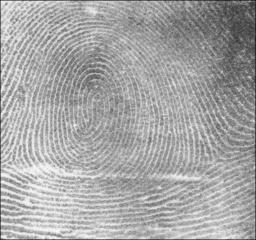
We hope that these examples of judicial murder are isolated, one-in-a-million freaks of misadventure that are, with forensic technology advancing apace, not to be repeated. However, a piece of research has recently come to my attention that, if its data accurately reflect reality, means that these sorts of errors may have been and may still be far commoner than previously thought. The paper, Contextual information renders experts vulnerable to making erroneous identifications by Itiel E. Dror, David Charlton and Ailsa E. Peron of the University of Southampton, casts chilling doubt on the value of evidence that has been regarded as the “gold standard” of forensic evidence—fingerprints.

What they did was take five fingerprint experts from various agencies and give each of them a pair of fingerprints (latent and a rolled exemplar) that they had each several years before found to be a match. The experts were told that the latent print was one lifted from the suitcase used in the Madrid train bombings and the rolled print was that of Brandon Mayfield, who had been wrongfully arrested for the crime but had since been cleared. Four of the experts changed their minds and ruled that the prints were not a match (they actually were a match, and had been verified blind by two other experts).

Another more comprehensive study had similar results:

Despite the absence of objective standards, scientific validation, and adequate statistical studies, a natural question to ask is how well fingerprint examiners actually perform. Proficiency tests do not validate a procedure per se, but they can provide some insight into error rates. In 1995, the Collaborative Testing Service (CTS) administered a proficiency test that, for the first time, was “designed, assembled, and reviewed” by the
International Association for Identification (IAI). The results were disappointing. Four suspect cards with prints of all ten fingers were provided together with seven latents. Of 156 people taking the test, only 68 (44%) correctly classified all seven latents.

Overall, the tests contained a total of 48 incorrect identifications. David Grieve, the editor of the Journal of Forensic Identification, describes the reaction of the forensic community to the results of the CTS test as ranging from “shock to disbelief,” and added:

“Errors of this magnitude within a discipline singularly admired and respected for its touted absolute certainty as an identification process have produced chilling and mind-numbing realities. Thirty-four participants, an incredible 22% of those involved, substituted presumed but false certainty for truth. By any measure, this represents a profile of practice that is unacceptable and thus demands positive action by the entire community.”[2]

These studies show that fingerprinting, far from being the objective, scientific discipline that we thought it was, is in fact subject to the prejudices of the analysts charged with comparing the latent and exemplar prints. Every single conviction that has hinged on fingerprint evidence is suspect in the light of this research, and the results of the studies demand an overhaul of the methodology of analysing fingerprints.

I have never believed that the portrayal of fingerprint comparison as depicted in television programs like CSI are accurate. (A computer flashes prints on the screen, then beeps and flashes “Affirmative” annoyingly until someone shouts, “Eureka, we have a match!”) I did, however, think that there was some sort of scientific rigour in that the person doing the analysis would at least be insulated from the context of the case, in other words they would be given the prints and no other information, so their decision would be based solely on the prints and not on anyone else’s opinion as to whether or not a match is expected.

Another problem with fingerprints is that there are methods of planting a fingerprint on a surface near which the finger in question has never been. An example was uncovered in the Inge Lotz murder trial, where the breathtakingly incompetent police tried to plant Fred Van der Vyfer’s fingerprint on a plastic DVD case in Inge Lotz’s Stellenbosch flat in an attempt to place him at the murder scene. Fortunately for Fred, the dimwitted flatfeet had lifted the print from a curved substrate and planted it on the flat DVD case, which was obvious to the FBI experts hired by the defence, and Fred was acquitted.

So when I do inadvertently leave my thumbprint on the Kenwood Chef I use to convert you into dogfood (you know who you are), I’ll be able to so discredit the evidence that I’m quite sure I’ll get off scot free. You don’t feel so smugly secure now, do you?

[1] No one has officially exonerated Hauptmann, but the obviously fabricated “evidence” that secured his conviction leave very little doubt that he was innocent.

[2] Zabell, Sandy. “Fingerprint Evidence”. Journal of Law and Policy. http://wwy.brooklaw.edu/students/journals/bjlp/jlp13i_zabell.pdf.

Creative Commons License
Grumpy Old Man by Mark Widdicombe is licensed under a Creative Commons Attribution-Noncommercial-No Derivative Works 2.5 License