Drug Laws

January 29, 2010

Scallywag (who lights my darkness) enjoys the occasional herbal cigarette which she smokes in the evening.  Then, with slavering jaws and flashing teeth, she mows a great swathe through our household economy, necessitating an emergency midweek visit to the supermarket to replenish stocks of bread, eggs and dog pellets.  But, apart from giving her an appetite that would be the envy of the Ravenous Bugblatter Beast of Traal, her habit does no harm whatsoever to anyone except perhaps herself.

Yet if it reached the ears of the authorities that she she was partaking of this harmless substance she could be siezed by the rozzers and hurled, with the lowest thieves, perverts and murderers into the darkest dungeons Pollsmoor has to offer.  As sceptics we (rightly) rail against the absurdities of religion, quackery and pseudoscience wherever we encounter them; should we not also shine the light of reason onto the absurdities that make their home in the statute books of our country?

I challenge anyone to give me a rational reason why the mere possession of cannabis should be a criminal act, but alcohol and tobacco, which are arguably more harmful substances,  are legally available everywhere.

But the point is not the harmfulness of the substance—there is a more important principle to consider.  Governments are constituted to protect the individual’s rights from being infringed by others; that is the social contract.  It is a principal that no law should be passed that protects an individual against himself, because that is the foundation of the “nanny state” under which individual freedom is impossible.  If an individual wishes to smoke whacky weed, snort cocaine or shoot his veins full of heroin he should be permitted to do so, provided he does no harm to others by so doing.  Having dealt with the principle let’s move on to practicalities.

“But Mark,” you say, “what about the medical bills we the taxpayers have to foot when these junkies destroy their health?”  If the drugs were legal they could be taxed as are alcohol and tobacco now, and the taxes thus collected would be more than sufficient to offset any additional public health expenditure.

The illegal drug market is demand driven, and prices bear almost no relation to the amount it costs to produce and distribute them.  There is a huge risk premium built in because the distributers (criminals) risk imprisonment if they are caught.  Legalizing drugs would take the market out of the hands of gangsters and place it in the hands of entrepeneurs where it can be easily regulated.  Drug users would be able to rely on consistent quality and acurate doses at a far lower price than they are currently paying.

Which brings us to the question of crime.  The entire industry is controlled by organised criminal networks and the users themselves are often forced to indulge in crime in order to pay the exorbitant prices demanded by the gangs.  Were the products to be legalized, one of the props supporting organised crime would be be neatly amputated, and an all-round reduction in crime could be expected.  Government (disorganised crime) would receive a revenue boost that would be of benefit to ordinary taxpayers whether or not they are drug users.  Over 1,5 million people are arrested in the USA every year for drug offenses, most of which are trivial.  Imagine the reduction in crime that would be possible if the resources wasted on drug enforcement were to be diverted to combatting real crime.

Creative Commons License
Grumpy Old Man by Mark Widdicombe is licensed under a Creative Commons Attribution-Noncommercial-No Derivative Works 2.5 License.


Private Bitch

January 18, 2010

Privacy no longer exists. With cheap data storage and lightning fast computer processing private companies and government agencies are able to assemble dossiers on you whose details, were you aware of them, would make your eyebrows curl. Every time you shop using a credit or store card the details of your purchase are recorded against your name for use in targeted advertising, or anything else the diabolical retailer mind can think of. If you visit iffy websites don’t do it while you’re logged into any of your Google accounts (Gmail, Google apps, Google Wave &c) or the web addresses will be recorded against your name by Google. Yes, they have a “privacy policy” which says they won’t divulge the details to anyone else unless they are asked for them by the rozzers or anyone else, really.

This may sound paranoid, but you cannot assume anything is private. When you are talking to someone on the telephone you have to assume your conversation is being monitored (ask Prince Charles if you don’t believe me). Your emails are subject to audit by your ISP and any government agency that asks for them. Every time you leave your home you are likely to be watched on security cameras and your voice is recorded every time you ring a call centre.

What really astounds me, though, is that people don’t care. They hand over all their details without turning a hair. I recently wanted to move my cell phone contract from one service provider to another. I couldn’t believe my ears when they asked for three months’ bank statements. Er, excuse me, bank statements are confidential information. Even (especially) my wife doesn’t have access to them, why should I give them to a bunch of strangers?

I am part owner of a small business and on occasion I trot around the neighbourhood putting advertising flyers in mailboxes. (Yes, I am one of those annoying people. If you don’t wish to know of the enormous benefits that could be yours for a very reasonable price were you to become one of my happy customers, all you need do is put a notice on your mailbox reading “No Junk Mail” and that will be respected, even though I don’t regard my flyers as junk.) What amazes me is that so few people secure their mailbox in any way. I see boxes stuffed with bills, credit card statements, tax assessments and so on all conveniently available for the taking by anyone who wants to steal your identity. People just don’t seem to realize that information is a valuable commodity.

And what about all those forms we have to fill in all the time if we want to get anything done? All want impertinent information. Why should I supply my date of birth in order to purchase a CD online? My policy is to leave out information that is not required, and to lie about anything that is required but not essential to the transaction. I have a second email address for “junk” transactions; my “real” email address is given only to family and friends. I use false names wherever possible (Margaret Thatcher is one of my favourites), fake phone numbers and addresses and if they come up with “This field is required” in something that really isn’t any of their business, I fill in “None of your fucking business”.

I’m seriously considering getting myself a second identity (I may steal it from you), building up a collection of false beards and moving to my own private island staffed with robots (the one Scaramanga had in the James Bond movie would be ideal) and opting out of the plexiglass world.

Creative Commons License
Grumpy Old Man by Mark Widdicombe is licensed under a Creative Commons Attribution-Noncommercial-No Derivative Works 2.5 License.


Quotes

December 30, 2009


It used to be common for people to keep “commonplace books”, or collections of quotes garnered from books they had read. I’ve been doing this on and off for a while, and have collected some great quotes. Some are funny, some serious, but all are pithy and worth reading. Here is a selection of the best.

She’s like a woman, hard to manoeuvre, beautiful to behold, proud to be of service, but impossible to dominate.
Taki

Toward the end of minute five I searched my spiritual inbox for new messages and found only a feeling of faint surprise that looking at a picture can make one seasick.
Mary Wakefield

‘pestilent with English — a parcel of staring boobies, who go about gaping and wishing to be both cheap and magnificent. A man is a fool now who travels in France or Italy, till this tribe of wretches is swept home again.’
Byron

The condition of the free man is that he does not live for the benefit of others
Aristotle

I’m looking forward to a forthcoming Outreach Alignment Conference, where I intend to fully leverage all my synergies in a generally empowering way, retaining focus all the while as I interface (never talk) with colleagues in this strategic capacity-building programme.
Justin Marozzi

Last Christmas you were kind enough to carry an article in which I opined that reports of a massive Aids pandemic in Africa appeared to be exaggerated. I have since been accused of incest, homosexual tendencies, sexual perversion, incompetence, murder, ‘carbuncular’ practices, a secret alliance with President Thabo Mbeki, drinking too much, taking drugs and smelling bad.
Riaan Malan

We desire many things which it is not in our power to achieve: that we should be universally popular and admired, that our work should be the wonder of the age, and that the universe should be so ordered as to bring ultimate happiness to all, though not to our enemies until they have repented and been purified by suffering.
Bertrand Russell (Analysis of Mind)

There is nothing evil or degrading in believing oneself a teapot, but it argues a certain inaccuracy of the thought processes.
P. G. Wodehouse (The Coming of Bill)

The only point of interest is the men’s 100-metre final, a race between eight drug addicts to decide who has the best apothecary.
Lloyd Evans

I know a bit about dogs. It’s a single boast that lends relief to an otherwise unremitting inferiority complex.
Jeremy Clark

O men of infinite resource and sagacity, verily is it a cold day when you get left behind. Forge ahead.
P. G. Wodehouse (The Gold Bat)

A retired Scottish schoolmaster sends me his learned contribution to the debate in this column about the use of ‘may’ and ‘might’. Using the example cited by Philip Pullman of the difference between ‘Napoleon may have had homosexual tendencies’ and ‘Wellington might have avoided the Battle of Waterloo’, he writes that the difference ‘is, in effect what we Classicists call the principal clause (apodosis) of an unfulfilled past conditional sentence, with the omission/ suppression of the If clause (called the protasis)’. I think this should be the last word on the subject.
Charles Moore

How dreadful are the curses which Mohammedanism lays on its votaries! Besides the fanatical frenzy, which is as dangerous in a man as hydrophobia in a dog, there is this fearful fatalistic apathy. The effects are apparent in many countries. Improvident habits, slovenly systems of agriculture, sluggish methods of commerce, and insecurity of property exist wherever the followers of the Prophet rule or live. A degraded sensualism deprives this life of its grace and refinement; the next of its dignity and sanctity. The fact that in Mohammedan law every woman must belong to some man as his absolute property, either as a child, a wife, or a concubine, must delay the final extinction of slavery until the faith of Islam has ceased to be a great power among men.
Individual Moslems may show splendid qualities — but the influence of the religion paralyses the social development of those who follow it. No stronger retrograde force exists in the world. Far from being moribund, Mohammedanism is a militant and proselytizing faith. It has already spread throughout Central Africa, raising fearless warriors at every step; and were it not that Christianity is sheltered in the strong arms of science, the science against which it had vainly struggled, the civilisation of modern Europe might fall, as fell the civilisation of ancient Rome.
Winston Churchill The River War, p. 248-50, (1899)

What is the true and original root of Dutch aversion to British rule? It is the abiding fear and hatred of the movement that seeks to place the native on a level with the white man … the Kaffir is to be declared the brother of the European, to be constituted his legal equal, to be armed with political rights.
Winston Churchill London to Ladysmith via Pretoria (1900)

Opportunity is missed by most people because it is dressed in overalls and looks like work.
Thomas Edison

…nature requires that we should be able, not only to work well, but use leisure well; for, as I must repeat once again, the first principle of all action is leisure, but leisure is better than work and is its end.
Aristotle. Politics. Book VIII, 3

Give a man fire, and he’ll be warm for a day; set a man on fire, and he’ll be warm for the rest of his life.
Unknown

If once a man indulges himself in murder, very soon he comes to think little of robbing; and from robbing he next comes to drinking and Sabbath-breaking, and from that to incivility and procrastination.
Thomas De Quincey (1785 – 1859)

In theory there is no difference between theory and practice. In practice there is.
Yogi Berra

A government big enough to give you everything you want, is strong enough to take everything you have.
Thomas Jefferson

There’s no sense in being precise when you don’t even know what you’re talking about.
John von Neumann

Jesus saves. Buddha makes incremental backups.
Anonymous

The trouble with fighting for human freedom is that one spends most of one’s time defending scoundrels. For it is against scoundrels that oppressive laws are first aimed, and oppression must be stopped at the beginning if it is to be stopped at all.
H L Mencken

Atheist’s wager: Instead, my wager is that if there is a god, and it is a just god, then living a just and moral life will be acknowledged regardless of ones beliefs. If there exists an unjust or immoral god, then I could never satisfy both my conscience and such a god. My wager is that if the christians are right about god being just and all-knowing and all-loving, I will be rewarded if I act in morally sound, justified ways.
I don’t have any evidence that there is a god. To me, the idea of a god, or even of an afterlife pales in importance to what we experience everyday. Life. Life is the only thing that I “know” I have and when that is gone, I doubt I’ll be around to care, however, others will. I must live my life as I please, and since I believe I will only ever get one chance at it, I want to live it in the best manner that I can and help others do the same.
Anonymous

Question with boldness even the existence of a God; because, if there be one, he must more approve of the homage of reason, than that of blindfolded fear.
Thomas Jefferson

Believe nothing, no matter where you read it, or who said it – even if I have said it – unless it agrees with your own reason and your own common sense.
Buddha

A man’s ethical behavior should be based effectually on sympathy, education, and social ties; no religious basis is necessary. Man would indeed be in a poor way if he had to be restrained by fear of punishment and hope of reward after death.
Albert Einstein

I have never seen the slightest scientific proof of the religious theories of heaven and hell, of future life for individuals, or of a personal God.
Thomas Edison

It sounds odd to hear scholars and statesmen say the world is flat; but it is a fact that three Boers favored by the opinion of President Kruger prepared a work to support that contention. While I was at Durban they came from Pretoria to obtain data from me, and they seemed annoyed when I told them that they could not prove it by my experience. With the advice to call up some ghost of the dark ages for research, I went ashore, and left these three wise men poring over the Spray’s track on a chart of the world, which, however, proved nothing to them, for it was on Mercator’s projection, and behold, it was “flat.” The next morning I met one of the party in a clergyman’s garb, carrying a large Bible, not different from the one I had read. He tackled me, saying, “If you respect the Word of God, you must admit that the world is flat.” “If the Word of God stands on a flat world–” I began. “What!” cried he, losing himself in a passion, and making as if he would run me through with an assagai. “What!” he shouted in astonishment and rage, while I jumped aside to dodge the imaginary weapon. Had this good but misguided fanatic been armed with a real weapon, the crew of the Spray would have died a martyr there and then. The next day, seeing him across the street, I bowed and made curves with my hands. He responded with a level, swimming movement of his hands, meaning “the world is flat.” A pamphlet by these Transvaal geographers, made up of arguments from sources high and low to prove their theory, was mailed to me before I sailed from Africa on my last stretch around the globe.
Joshua Slocum

Do y’all have different books of the Bible than I do? Are y’all Gideons? Who are the ******’ Gideons? Ever met one? NO! Ever seen one? NO! But they’re all over the ******’ world puttin’ Bibles in hotel rooms. Every hotel room- “This Bible was placed here by a Gideon” When?! I been here all day. I ain’t seen ****! I saw the housekeeper come and go. I saw the minibar guy come and go. I never laid eyes on a ******’ Gideon. What are they- ninjas? Where are they? Where’re they from? Gidea? What the **** are these people?

I’m gonna capture a Gideon. I’m gonna make that my hobby. I’m gonna call the front desk one day. “Yeah. I don’t seem to have a Bible in my room.”
Bill Hicks

You don’t get rich writing science fiction. If you want to get rich, you start a religion.
L. Ron Hubbard, 1948

All the world is queer save thee and me, and even thou art a little queer.
Robert Owen

“Never, never marry, my dear fellow! That’s my advice: never marry till you can say to yourself that you have done all you are capable of, and until you have ceased to love the woman of your choice and have seen her plainly as she is, or else you will make a cruel and irrevocable mistake. Marry when you are old and good for nothing–or all that is good and noble in you will be lost. It will all be wasted on trifles. Yes! Yes! Yes! Don’t look at me with such surprise. If you marry expecting anything from yourself in the future, you will feel at every step that for you all is ended, all is closed except the drawing room, where you will be ranged side by side with a court lackey and an idiot!… But what’s the good?…”
Leo Tolstoy, War and Peace

…old rope labeled as Multi-Threaded Redundantly-Bonded Fully-Flexible Linear Load Bearing Facilitator.
Natehoy, Slashdot comment #30285772

there are only two sources of human vice–idleness and superstition, and only two virtues–activity and intelligence.
Leo Tolstoy, War and Peace

Sir, I wish to protest in the strongest possible terms. Having read your warning about the prurient nature of Nordic current affairs publications, I at once proceeded to their World Wide Web site. I am disappointed – nay, dismayed – to note that I in fact had to look quite hard before I could find any “tits and ass”, and in fact, the tits I did find were covered with an (opaque) brassiere. I demand that you retract your position at once. I further demand some hyperlinks meeting the promising description previously offered.
Yours, Henry Arthur George James Smitherington-Smitherington-Smitherington-Smitherington-Smitherington-Smitherington-Smitherington-Smitherington-Smythe (Mrs).
u38cg, Slashdot comment #30380202

Good judgement comes from experience, and experience comes from bad judgement.
W. Wriston, former Citibank CEO

When played with skill and grace, the game of soccer is like poetry in motion. Which explains all the bored-stiff people just pretending to follow along.
The Onion Horoscope

Creative Commons License
Grumpy Old Man by Mark Widdicombe is licensed under a Creative Commons Attribution-Noncommercial-No Derivative Works 2.5 License.


Hot Air

December 4, 2009


I am not a scientist. In fact I have no degrees of any kind (except the Ph.D. I downloaded from the internet and which looks lovely on my office wall next to Dufus’s rabies vaccination certificate). I therefore have to trust what scientists tell me about their research. I have been following the research into climate change in general, and anthropogenic global warming (hereinafter referred to as AGW) with keen interest.

When AGW was first suggested I was, properly, sceptical. The evidence that atmospheric CO2 levels were increasing was incontrovertible; it was and is an objective fact, but the controversy lay in the effect increasing CO2 levels would have on global climate. Some scientists hypothesised that the increased CO2 concentration in the atmosphere would act like a blanket and increase atmospheric temperatures globally. The political left seized on AGW as a convenient club with which to lambast the things they despise: Big Business and the Nasty Capitalist West. Since then it has become increasingly difficult to separate the political from the scientific.

As time went by it seemed that the AGW proponents were winning the debate; the science seemed solid even though they invited suspicion by always prefacing their arguments with a claim that the debate was over, and that all sane people agreed with them. Writers like Lomborg in The Sceptical Environmentalist disagreed, and I could not believe the vituperative passion with which his arguments were met–real scientists do not froth at the mouth and wax hysterical when someone disagrees with them. A holder of a minority opinion is not necessarily a crackpot.

Of course there were ridiculous arguments from the other side as well. The usual army of nut jobs and conspiracy theorists crawled out of the woodwork to claim, bizarrely, that AGW was dreamed up by the oil companies to ensure that they received funding for research into alternative energy sources that would allow their survival after the oil ran out, or that it was a US government conspiracy to save the power grids from failing due to excessive electricity consumption. And so on.

The real problem with AGW theory is that there is only one experiment that can reliably test whether or not its predictions are true, and that is the real-time one in which we are all taking part. By the time the results are known, it is too late to take remedial steps if the theory is vindicated. Other experiments take place in model environments which are acknowledged, even by their architects, to be deeply flawed. Not enough is known about atmospheric dynamics to construct accurate models, and we don’t have sufficiently powerful computers to run the models even if we could construct them.

And now this. Emails and other data retrieved by a hacker from servers at the Climate Research Unit at the University of East Anglia show that some of the leading climate researchers have systematically “massaged” data to fit their theories, perverted the peer review process to silence criticism, and failed to release the raw data for review by claiming copyright over it. You may think, as I did, that the University of East Anglia is hardly a Harvard, or Oxford, or University of Cape Town, and that this is therefore a storm in a teacup, but the truth is that the UEA Climate Research Unit is a major supplier of data to the International Panel on Climate Change (IPCC), the UN body that is responsible for the climate circus playing out in Copenhagen, and before that in Kyoto and Johannesburg.

So where do we go from here? Just because some scientists have, perhaps, used unethical practices does not prove them wrong, just as an invalid argument can have a true conclusion. Even if they are wrong there are still compelling reasons to pretend that they are right and cut down on the pollution we pump daily into our atmosphere and water. What sane person would prefer to breathe dirty air over clean, or have toxins in his drinking water? But what will cleaning up our act cost? We cannot sustain our population without mechanized, industrial agriculture which relies on fossil fuels; fertilizers require oil for their manufacture; food must be transported in bulk to the cities where people live, which is impossible without trucks, ships and trains, all of which rely on fossil fuels and pump CO2 into the atmosphere; the people in the cities must work in order to pay for food, which requires power in the form of electricity which is mostly generated by the burning of fossil fuels. In short, our species will suffer a population collapse (with attendent misery and violence as people fight each other for dwindling resources) if it were suddenly deprived of the energy sources provided by fossil fuels. Alternative sources such as nuclear, hydroelectric, wind and solar can only provide, with current technology, a fraction of our needs.

Another consequence of this scandal is that the man in the street will lose faith in the integrity of science. Once he thinks scientists have been guilty of crying wolf and playing fast and loose with the facts, he will take everything they say in future with a pinch of salt. He will accord them the same (or less) credibility than his priest or sangoma, which would be disastrous. We must come clean now. I call on the CRU to release the raw climate data and the source code of their climate models immediately, so their conclusions can be independently verified.

Creative Commons License
Grumpy Old Man by Mark Widdicombe is licensed under a Creative Commons Attribution-Noncommercial-No Derivative Works 2.5 License.


Cricket Bag

November 19, 2009


Time hangs heavy when one is in exile and it is the weekend. That is why, a Sunday or two ago, I found myself in a place I never dreamed I’d visit. A romantic place: a place where Camparis were first tasted, a breeding ground for gorgeous Oscar-winning stars. Benoni. Doesn’t the mere sound of those three syllables quicken the blood, fill the head with foolish fantasies and…never mind, me neither, but we’ve got to try.

My reason for being there was that I have a hobby, one that has afforded me enormous joy since boyhood. I rarely get to indulge my pleasure when I’m home because Scallywag does not, for some inexplicable reason, share my enthusiasm and I am keener on her than on watching cricket.

Willowmoore Park is a pretty ground. The spectator area is mainly grass embankments upon which people set up their deck chairs, plastic gazebos and picnic blankets. There is a small area at the North end of the ground with standard grandstand plastic seating, which is where I went because it is more or less behind the bowler’s arm in line with the pitch—the best place from which to watch, and I don’t possess a deck chair. It was a beautiful, hot summer day.

The game began. Zimbabwe had won the toss and put us in to bat. Things were going fine, especially after that gum-chewing, spitting buffoon Smith was out, predictably by waving his bat ineffectually at a ball wide of the off stump. Will he never learn? AB DeVilliers was in fine form, as was Hashim Amla. The seat beside me, which had hitherto been empty was suddenly filled by a lady in yellow. “HOOOOOOOOOOOOOOO-OO. COME ON BOOOYES! HOOOOOOOOOOOOOOOO-OO.”

I cringed. A symptom of what dread psychiatric disease could this possibly be? Could this awful howling mean that I was sitting beside a werewolf who had perhaps mistaken the Sun for a full moon? And to which boys was she referring? Her clothing gave no clue; she waved no flag. Perhaps she was unaware that there were two teams doing battle on the field and both were composed exclusively of boys.
“HOOOOOOOOOOOOOOOOOOOO-OOOoo” She ran out of breath, then hauled another couple of lungsful aboard. “BOOOOOYES!”

This was intolerable. What happened to the traditional cricket shouts such as “HIT THE RUBBISH!” or “HEY UMPIRE! YOUR GUIDE DOG GRAZED MY HAMBURGER!” I gathered up my esky and started to trek 180 degrees around the ground to the South side where the caterwauling might be less intrusive. As I walked I recalled that I had heard something similar in a televised American reality show. When a man whom the female members of the audience deemed sexy came onto the stage, they started howling in the same manner as the cricket lady. So could this be a sign of sexual excitement? None of the women I have known have impersonated an escapee from the island of Dr Moreau, not even when I have taken my clothes off.

Perhaps it’s just that I’m not very sexy.

Creative Commons License
Grumpy Old Man by Mark Widdicombe is licensed under a Creative Commons Attribution-Noncommercial-No Derivative Works 2.5 License.


Bally Ache

November 17, 2009

Lance Armstrong -- Survivor


I am not a doctor. I do, however, possess a body heir to the usual ills, so I take a keen interest in the medical sciences. One thing I have noticed is that genuine medical research is published in medical journals such as the Lancet or the New England Journal of Medicine and doesn’t make it into the mainstream media at all for the most part. If it does, it is often sensationalized by journalists who do not understand how the scientific method or the protocols of medical research work. The result is often something similar to what is reproduced, in all its ghastliness, here.

The treatment is worse than the disease!
Christine O’Brien
Contributor to Nutrition and Healing

The number of problems that survivors of testicular cancer are facing is much higher than previously thought. Simply because mainstream medicine just didn’t bother to take a look until now.

Clinicians only report treatment problems that are life-threatening or require medical intervention. And they only monitor most patients for five to ten years after treatment, meaning that many men suffering the after-effects of toxic cancer treatment have simply fallen through the cracks.

But researchers are finally getting a clue and took a look at data from the past 20 years.

Of course, what they’ve found is more or less all bad news. In a study that appeared in the Journal of the British Association of Urological Surgeons, researchers detailed an alarmingly long list of long-term effects.

Details like: Sensory nerve damage in 10-30% and hearing loss in 20% of patients on cisplatin-based (a platinum-based drug) chemotherapy. Pulmonary complications in men over 40 who are treated with bleomycin (an antibiotic) before surgery. Premature thickening of the arteries. Chronic fatigue in 17% of survivors (that’s nearly twice the normal population). And survivors are nearly TWICE as likely to develop secondary cancer.

This laundry list of threats to your health didn’t keep researchers from reaching for some good news. They reported that, “on a more positive note” up to 80% of men who try for fatherhood after treatment are successful.

I’m sorry, but with the possibility of permanent nerve damage, secondary cancer and hearing impairment, that doesn’t just seem to be enough of a silver lining.

Let’s hope that this serves as an example of why a close look at the long-term is so critical. I couldn’t help but think of the recent swine flu vaccine studies – they gave the drug the seal of approval after only a month of safety trials.

And now there are promises of protection from the pandemic – but who knows what long-term risks are waiting around the corner? And are we willing to sacrifice our lives for short-term benefits?

Let’s start with the title. Is a 20% chance of hearing loss or a 17% chance of developing chronic fatigue years or decades in the future really worse than dying of testicular cancer now? Perhaps Ms O’Brien’s cavalier attitude could be traced to the fact that she, presumably, does not possess testicles, cancerous or otherwise. Or perhaps the nonsensical headline is merely a means of grabbing eyeballs and the actual article might make some sense.

Alas, the first paragraph puts paid to that optimistic hope. The horrible ogre “mainstream medicine” couldn’t be bothered to “take a look until now”. Codswallop. If Ms O’Brien has a means of foretelling the side effects of a treatment given now which will manifest themselves decades in the future she should disclose it now; the medical fraternity will, I’m sure, be agog to hear it and the Nobel Committee will fall over themselves to honour her. Or perhaps she thinks clinical trials should last for a minimum of the average human lifespan before a drug is approved for use.

I think it was Benjamin Disraeli who first referred to “lies, damn lies and statistics”. The problem with statistics is that, whilst they are incredibly useful if properly used, they are extremely easy to misinterpret through ignorance or to misrepresent in an attempt to shore up a shoddy argument. Ms O’Brien has made extensive use of the latter technique here. Let’s have a look.

Firstly, the quoted statistics have little or no relevance to current treatments. Ms O’Brien neglected to tell us that “Some relevant observations, in particular those referring to long-term effects, are from survivors treated with ‘outdated’ therapies, although many of these survivors, treated after 1980 are still alive and with a life-expectancy of 20–30 years.” We are not told this because it makes the whole thesis of the article irrelevant.

17% chance of developing chronic fatigue? Well, unless we read the actual paper we would never know that this is in contrast to 9.5% of men who do not have testicular cancer and that “Compared to those not fatigued, the survivors with chronic fatigue were older, had less education, more unemployment and economic problems, hazardous alcohol use, somatic comorbidity, neurotoxic side-effects, mental distress after treatment, depression, anxiety, and cancerrelated distress, poor HRQL, high level of neuroticism, and a less satisfying sexual life.” Just reading that gives me chronic fatigue.

22% hearing loss? No, 22% ototoxicity, ranging from tinnitus to hearing loss, no other information provided. And so on.

A truly horrifying statistic that Ms O’Brien chose not to present is that 10% more testicular cancer survivors marry than their cancerless brethren. This is where I expect people to point out that correlation does not necessarily mean causation and that some other factor may be at play.

Ms O’Brien concludes her ridiculous rant with the question: “And are we willing to sacrifice our lives for short-term benefits?” But that is precisely what she are asking her readers to do. Sacrifice their lives for fear of long term consequences that may or may not arise in the face of the mortal peril they are facing now.

Creative Commons License
Grumpy Old Man by Mark Widdicombe is licensed under a Creative Commons Attribution-Noncommercial-No Derivative Works 2.5 License.


Flax and Cheese

November 6, 2009
185px-Olej_lniany

Flax seed oil

“Honey, I’m home!”  Fred Bakelite was in his late forties, tennis fit and looked young for his age.  His polyester leopard-skin suit was still immaculate, even after a hard day at DuBridge Industries.  “Where aaaarrree yoooouu, sweety?”

“Right here, light of my life, floater of my boat, churner of my butter.”  Margeret Bakelite kissed her husband tenderly on the lips.  They wrapped their arms around each other, stood cheek-to-cheek awhile, sighed, then split apart, she to the kitchen and he to the drinks cabinet.

“How was your day?” she called from the kitchen.

“Not Bad,” he replied. “That Barney Nylon dropped the ball on the PolySyne contract.  I’ll probably get the promotion when old Yurethane kicks the bucket.  It’ll mean a big increase.”

“Wonderful.  Did you have your medical?”

“Oh yes, I forgot to mention.  I’ve got the body of a twenty year old except for bowel cancer.  Doc Multistix says I must have an immediate operation or it’ll spread and kill me.  Well, you know what a sceptic  I am, I did my own research and you know what?  I can easily be cured!  Without an operation!”

Margeret came rushing through from the kitchen.  “What are you talking about?  Good grief Fred, this is the time to take expert opinion and to hell with these weird ideas of yours!”  Her gorgeous green eyes were humid with concern.

“Ha ha,” Fred laughed. “I understand you’re worried about me, you silly thing, but just look at this.”  He whipped open his briefcase and extracted a thick folder.  “Look, I printed this out to show you and that old fool Multistix.  There’s this woman from Germany, her name’s Johanna Budwig.  She’s been nominated for the Nobel Prize six times!  Actually some of the sites I got from Google show she’s been nominated nine times.  She has this treatment for cancer that is just cottage cheese and flax seed oil.  It has a 100% success rate!”

Margeret looked doubtful.  She took the folder from Fred and perused it, biting her lips.

“I thought nominations for the Nobel Prize were secret.  How does anyone know who was nominated, or how many times?”

“Well, I don’t know.  The people who put these sites up are probably on the committee.  They’d know, obviously.  Why  don’t they come up with the same answer?  I don’t know, how could I?  This is just typical of you—tryng to shoot down my every idea.  You really aren’t being very supportive at a hard time for me.”

“Oh, Fred, you know perfectly well I’m not trying to be nasty.  It’s just that if this was really a cure for cancer, wouldn’t everyone have heard of it?  Wouldn’t she actually have been awarded the Nobel Prize instead of just being nominated for it?”

Fred sighed.  “Well, that’s what people would say.  As you can see from this document here, the reason she hasn’t had the recognition she deserves is that the big pharmaceutical companies are making too much money selling standard chemotherapy drugs to allow this simple cure to become known.  The ingredients are not patentable, therefore no one can make money from them.”

“What’s flax seed oil?”

Fred grinned.  “I thought you might ask that, so I got some.”  He reached into a pocket in his brief case and produced a small blue bottle with what appeared to be a ghost depicted thereon.  He unscrewed the cap and wafted it under Margeret’s nose.  “Ring any bells?” Fred asked, his head bobbing idiotically in anticipation.

“Oh.  My.  God.  You’re mad.  Now I know it.  I haven’t smelt that since our schooldays.  How many years ago?  Yes, that day you shagged me in the pavilion.  I was only fifteen you bastard.  What’s that thing?”  She indicated a thin folder in Fred’s open briefcase.

“Oh.  That’s a life insurance policy I took out months ago.  I’ve been meaning to give it to you for filing.  You’re the beneficiary, obviously, it’s for two million bucks.  Thanks to Johanna you won’t be collecting. ”

“I’ll take it in any case and put it away.  I’ll be off to bed.  Enjoy your cottage cheese and cricket bat oil.  See you later.”

There was a small smile on her face and a wicked gleam in her eye as she left the room.


Creative Commons License
Grumpy Old Man by Mark Widdicombe is licensed under a Creative Commons Attribution-Noncommercial-No Derivative Works 2.5 License.


On Intelligent Design

October 16, 2009
J.M. Coetzee

J.M. Coetzee

I have been reading Diary of a Bad Year by J.M. Coetzee.  It includes a short homily entitled On Intelligent Design, which contains this surprising, in view of its authorship, statement:

I continue to find evolution by random mutation and natural selection not just unconvincing but preposterous as an account of how complex organisms come into being.

Apart from his personal incredulity, Mr Coetzee offers no argument or evidence against mutation or natural selection.  He does not deny that evolution takes place, just that it does not make the grade as an “account of how complex organisms come into being”.  This is fortunate because the evidence for evolution actually occurring is overwhelming: to deny it is akin to denying gravity or believing that the Earth is flat.  He does, however, go on to state that he disbelieves in a personal god who answers prayers and punishes evildoers, but he does believe in some creative intelligence:

It does not seem to me to be philosophically retrograde to attribute intelligence to the universe as a whole, rather than just to a subset of mammals on the planet Earth.

Whether or not such a view is philosophically retrograde is a question for philosophers.  As an ordinary person, I  regard the statement as nonsensical.  Why would anyone ascribe intelligence to the universe as a whole rather than, say, a grain of sand, or a pine tree, or a 1967 Valiant Safari?  All are collections of matter and energy that obey well-established physical laws and show no signs of intelligence at all.

Charles Darwin

Charles Darwin

So far, so bad.  Mr Coetzee then challenges those who believe evolution is responsible for the biodiversity that we see to answer this question:

Why is it that the intellectual apparatus that has evolved for human beings seems to be incapable of comprehending in any degree of detail its own complexity?  Why do we human beings typically experience awe—a recoil of the mind, as if before an abyss—when we try to comprehend, grasp, certain things, such as the origin of space and time, the being of nothingness, the nature of understanding itself?  I cannot see what evolutionary advantage this gives us—the combination of insufficiency of intellectual grasp together with conciousness that the grasp is insufficient.

OK, I’ll give it a try, and if it comes out the way I think it might, the answer to the question may very well go some way towards explaining Mr Coetzee’s incredulity.

Firstly, the question itself is a non-sequitur; evolution does not depend in any way on the capacity of the human brain to understand itself.

Secondly, not every attribute of humans confers an evolutionary advantage.  Take as an example the mess that is the human upper respiratory tract, which is still optimised for an animal that moves on all fours.  Bipedalism has conferred more of an advantage than the disadvantage of a flawed, dangerous respiratory system.  The flaws in human design are some of the strongest arguments against intelligent design.

The entire question betrays a fundamental misunderstanding of what evolution actually is.  To ask “why” evolution produces this or that feature in a species is to assume that it is goal-oriented, that it is working toward some purpose.  It isn’t.  Over time, the changes that “work”, or cause the organism to have a higher chance of surviving and reproducing are passed on, those that impair the organism are not.  There is no goal or even direction to evolution.  The egotistical notion that humans are the topmost twig of the evolutionary tree is simply wrong; it is quite conceivable that we might die out and have our place taken by some currently ill-regarded species which better adapts to conditions than we do.

Humans evolved to survive on the Earth.  That they were successful in that endeavour is evidenced by the fact that we human beings are here to discuss it.  In order to survive we had to have a firm intuitive grasp of our environment on the scale of our prey and potential predators. There was not, and still isn’t, any evolutionary advantage to be had by an understanding of quantum mechanics or relativity, because the effects of those phenomena are only evident at scales very different to those required for human survival on Earth.  Our individual lifespans are measured in decades; we have no intuitive understanding of the billion year time spans over which evolution takes place.  The very small, the very large and the very long ago are beyond the capacity of our brains to grasp, because there is no evolutionary reason for us to grasp those concepts.

It is because these things are intrinsically so alien to our everyday lives that we experience the “recoil of the mind”.  We cannot imagine the distances to the galaxies (or even the stars in our own galaxy), the size of a subatomic particle or the age of the Earth; these things do not fit into our imaginations; they must be expressed in a way that allows us to perform calculations and make predictions, but we can only understand them in a dry, intellectual way not intuitively as we understand the parabola of a thrown rock or the acceleration of a falling coconut.

Perhaps this is why Mr Coetzee and others instinctively find the notion of evolution preposterous.  Because they cannot intuitively grasp the time scale involved, they imagine that all this happened in a time scale they can imagine, which would be preposterous.

Creative Commons License
Grumpy Old Man by Mark Widdicombe is licensed under a Creative Commons Attribution-Noncommercial-No Derivative Works 2.5 License.


Nano Nonsense

October 9, 2009

Every day I receive in my inbox a financial newsletter which tells me what’s going to happen in global markets and where I should most profitably be investing my non-existent wealth.  Usually I read it avidly, dreaming of yachts and private jets, and skip impatiently past the blue advertising links embedded at various points in the text.  But yesterday was a slow day, and I clicked on a link because it contained the phrase “nano-technology” and I love all things scientific and technological.

What a shock!  It seems we are all about to be consumed by flesh-eating bacteria!  Medicine is powerless!  A worldwide conspiracy of government glitteratis has succeeded in keeping this secret from us, but now it is out.  But do not despair!  In a message that begins “Dear Germ-Conscious Friend” salvation is promised.  It comes in the form of a device that appears to be no bigger than a cellphone and is catchily called the New Nano UV Disinfectant Light Scanner.

This amazing little device kills an incredible 99.99% of bacteria and viruses in ten seconds flat!  Now I know that 93% of statistics are made up, but this surely looks as though it might be true?  Any lingering doubts are dispelled when we are informed that this “proven, working technology” has been tested and given certification by independent laboratories.

A Happy Customer

A Happy Customer

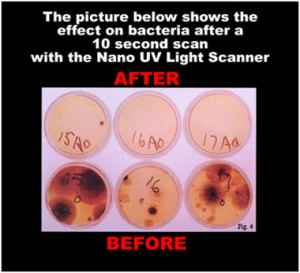
I read avidly on, because I still haven’t got to the bit where the “nano” comes in.  It seems a person called Eleanor Smith has purchased one of these doohickies and is delighted, her testimonial is above, unless it comes out below.  Still haven’t got to the nano nitty-gritty yet, but here’s a relief: it’s 100% chemical free!  I wonder what it could be made of?  Here’s a picture (above or below) that constitutes absolute proof that this thing is on the up-and-up.  I do wish they would put the “order” button at the top of the page—I could already have had one instead of still stupidly risking my life amongst all these horrible ravenous “E. Coli” and “C. Difficile”.

Proof Positive?

Proof Positive?

I get to the bottom, and still no explanation of the “nano”.  Just this: “Now, using state of the art nano technology and multi-wavelengths including UVA-, UVB- and UVC-light…”  Is it possible?  No, surely they wouldn’t be so base as to use a scientific term to hoodwink, would they?  That’s what “quantum” was invented for.  If only they’d said: “in a revolutionary new application of quantum entanglement this device will provide 100% protection against being run over by buses or hit upside the head by falling meteorites” I would have smelled a rat immediately.  Cunning rascals; we’d better have a sceptic take a closer look at their claims.

“By Jove, Holmes, look at this photograph!  It’s obvious this thing has utterly destroyed these germ colonies.”

His lips stretched in a sardononic grin and his ice-blue eyes glittering, Holmes whipped out his magnifier and examined the photograph closely.  “You notice, Watson, that the hand-written labels on the bottom row of Petri dishes labelled ‘before’ do not appear to match those on the top row, labelled ‘after’.  The formation of the characters is quite different.”

“Gosh!  You’re right, Holmes.  So this light effects handwriting as well as killing germs!  That is astonishing!”

“Would a better explanation not be that they are not the same Petri dishes?”

“But that would mean…”  Watson tottered, his face ashen.

“Precisely, my dear Watson.  These miscreants are using a new technique we detectives call ‘lying’.  It consists of deliberately misrepresenting facts in order to cause their victims to believe things which are not true.”

“God, what can the world be coming to?”

Why not just take a photograph of a virgin petri dish, then grow bacteria in it, take another photograph then lie about which one was taken first?  That’s the way I’d do it.

There is so much else wrong with this advert that it is hard to know where to start critisising it.  There is the same ignorance of how to render biological names that I have complained about in another context; there is the typical scare tactic followed by the ‘white knight’ in his lab coat riding to the rescue; the appeal to authority (certificates and accreditation, for what? It doesn’t say, possibly for being safe to use in submarines); the use of scientific-sounding jargon which the ignorant lap up like ambrosia.  And on and on.

Does this thing cause harm, though?  Probably not, unless you shine it in your eyes for too long, or eat it, or poke it into bodily orifices.  If the Eleanor Smiths of the world derive comfort from it and are prepared to part with R699.95…WHAT?!  This thing probably doesn’t cost more than ten bucks to make.  They’ve made me use an interrobang I’m so gobsmacked.  Oh, wait, they give you a couple of free batteries as well.  That’s OK, then.

Is it wrong to poke fun at or make money out of the idiots who infest this planet?  After all, it’s not their fault they’re fools.  Nope, if you can’t be bothered to think, you will get what you deserve, which is your money taken, and perhaps a dose of C. difficile as well, whatever that might be.

Creative Commons License
Grumpy Old Man by Mark Widdicombe is licensed under a Creative Commons Attribution-Noncommercial-No Derivative Works 2.5 License.


Ad Break

September 30, 2009

california_mistake5

Is it my imagination or is advertising getting much worse than it used to be?  I remember the day when creative people in the advertising industry actually were creative, it wasn’t just a job title.  The mouse on the BMW steering wheel; the Santam farmer and taxi driver; even braaivleis, rugby, sunny skies and Chevrolet.

What do they dish up now?  That horror from cybersmart sung to the tune of Nkosi Sikelele, that’s what.  The person responsible for that sould be taken down to the basement and shot.  Those idiotic ‘punchlines’ where the simpering housewife giggles something along the lines of ‘it’s so simple even my husband can do it.’  Ha.  Ha.  Fake American accents advertising websites: ‘no wonder you get hit on so much!’  Oh God, stop.  My sides are splitting.

A few months ago in a boardroom at the Standard Bank headquarters a meeting was convened to discuss the bank’s new catchphrase.  Or tagline, or whatever it is they call those things.  The old one was: Simpler, Better, Faster.  Utterly untrue—the bank in question has possibly the worst service standards in the galaxy, but perhaps they were expressing an ambition, not reality; in any case it wasn’t bad as catchphrases go.  So what did those grey heads in the boardroom decide the replacement should be?  Moving Forward.  I’m not joking.  WHAT THE HELL IS THAT SUPPOSED TO MEAN?  I know what the words mean, but in the context of banking they are meaningless drivel.  Not only did someone in the advertising industry lack the humility to actually pitch this rubbish, but people in high positions at Standard Bank saw fit to approve it as encapsulating their corporate vision.

If I had my way, Sandton basements would see more shootings than the Lubyanka in Stalin’s heyday.